THE DIFFERENCE
The step that stops being a step.
The standard sequence in residential construction is design, bid, build. You design the home, you put it out to bid, and you build whatever you can still afford of it. Budgeting is something that happens to you at step two.
We run budget, design, build. The budget is established first, in a working session with Mike before a designer draws anything, and every decision after that gets priced against it while you are still deciding. By the time the traditional route reaches its bid, ours has already been priced line by line for months. There is no moment where you find out what you can afford — and there is a fourth step the traditional route does not have at all.

WHAT THIS PROTECTS
Budget Integrity
The budget is set before design starts, and every decision is priced as you make it. Roughly 100 cost categories are documented before you sign anything.
Timeline Reliability
The schedule is built during pre-construction, not improvised during construction. It lives in JobTread, and you can open it on your phone.
Proactive Communication
Weekly client meetings, with the cadence agreed before the project starts, so nobody has to chase anybody.
Quality of Work
Standards set by two Master Carpenters, and a written quality control checklist walked with every subcontractor at each and every phase of construction.
PHASE 1 · BUDGET
1. Establish a realistic preliminary budget
It starts with a free phone call to get a preliminary range, then a working meeting with Mike to build a real one. Whole project: land, design, site improvements, construction, and the professional fees in between. Not the house on its own.
What this means for you: You find out what your project actually costs before you have spent anything on it
PHASE 2 · DESIGN
2. Design to a target construction budget
The designer works to a number rather than to a wish, and Sherman sits in the design meetings. That second part is the
one most builders skip.
What this means for you: The house that gets drawn is a house you can afford to build
3. Value engineer to optimize your investment
As the design develops, Mike and Ben bring you alternatives with real costs attached. A different material, a different
span, a different detail, the same result for less.
What this means for you: Your money goes into the things you care about instead of the things nobody thought to price.
PHASE 3 · CONTRACT
4. Document every construction detail and cost
Roughly 100 cost categories, each one filled by a real bid from a real trade. Finish selections made and priced. Nothing
left as an allowance that could have been a number.
What this means for you: About 95% of what your home will cost is known and written down before you sign anything.
5. Contract on complete information
A formal bid built from documented costs, and a construction contract based on it, along with your building permit and
loan submittal packages.
What this means for you: You sign a contract for a house that has already been priced, not one that will be.
PHASE 4 · BUILD
6. Stay on schedule
The construction schedule is built during pre-construction and sequenced by people who know how each phase has to
land before the next one can start. It lives in JobTread, alongside Teams, SharePoint and the rest of the management
suite.
What this means for you: You can open the schedule on your phone, any day, without asking permission.
7. Stay on budget
Change orders happen when you change your mind, or when the ground does. They are priced the same way every other line was priced, at cost plus the fee you already agreed.
What this means for you: The number you signed is the number you are still working from in month nine.
8. Communicate regularly
Weekly client meetings, agreed in advance, with photos, calls and written updates in between.
What this means for you: Nobody has to chase anybody. That single fact is what most of our reviews are actually about
9. Ensure quality and durability
A written quality control checklist of over 400 task items, walked with every subcontractor, with the standards behind it set by Mike and Ben.
What this means for you: Every detail is checked by the person who set the standard, at each and every phase of construction.
PHASE 5 · ENJOY
10. Move in, and start using it
The build is finished when the house is genuinely ready — cleaned, complete, and working. What happens after that is the part this whole process was for. Our clients tend to describe the same thing: the room they did not expect to live in, the view they still notice, the first holiday with everyone in the kitchen at once.
What this means for you: the fourteen months end. The house is yours for the next thirty years and beyond.
“Good communication and follow-through are the keys to happy clients and fast, efficient construction projects.”
MIKE SHERMAN · PRESIDENT
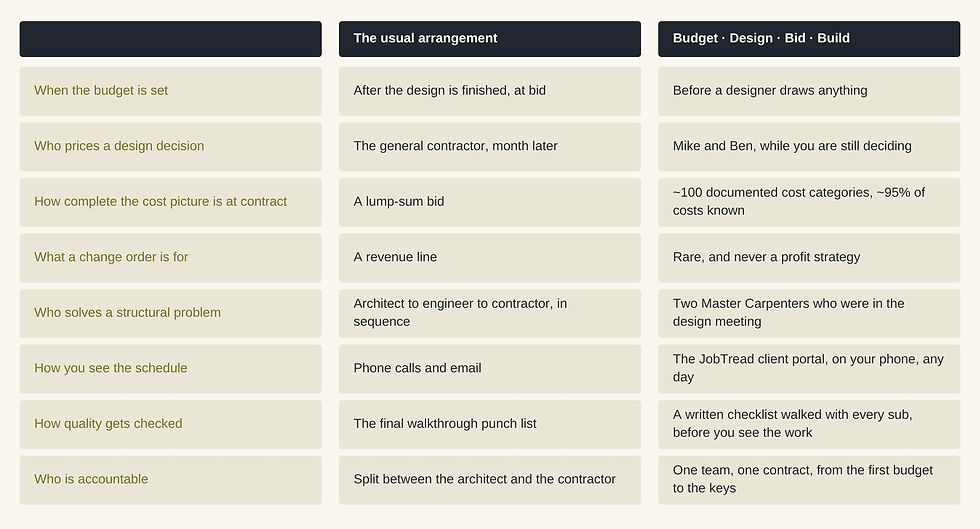
THE COMPARISON
Master Carpenter-led, against the way it is usually done
Same four activities in both columns. What differs is the order they happen in, and who is in the room when the money gets
decided.

HOW LONG
About fourteen months, and why nobody can tell you that on a phone call
A typical Sherman custom home runs around fourteen months of construction. Pre-construction adds to that, and how
much depends on your lot, your county, and how quickly decisions get made.
Anyone who gives you a construction schedule before they have seen your lot is guessing. Slope, soils, access, water, septic,
power and your county’s plan check all move it. What we can tell you on a first call is a range, and what would narrow it.